This is the first piece in a new series built on our own numbers: aggregated, anonymised data from the paid media accounts we run across private healthcare.
We are starting with the thing every healthcare marketing manager is currently being asked to explain. Louis Meletiou is joined by Senior Account Manager Joe Reid to walk through a year of auction data, split specialty by specialty: weight management clicks now cost nearly two and a half times what they did a year ago, while a handful of specialties got cheaper.
There is also a game show. Joe did not enjoy it.
What we cover
We compared April to June 2026 against the identical campaigns in the same quarter of 2025. Same accounts, same campaigns, same season, twelve months apart.
Blended cost per click up 22%, from £1.07 to £1.30.
Blended cost per acquisition up 29%, from £14.08 to £18.13.
Click through rate broadly flat, 7.45% to 7.22%.
If click through rate had collapsed you could blame tired creative. What we are seeing is the auction price changing.
Search CPC by specialty, Q2 2025 versus Q2 2026
Same campaigns a year apart. Anonymised and aggregated across five advertiser accounts. Non brand campaigns only. Where more than one account competes in a specialty, the figure is the spend weighted blend. Categories follow how these accounts group their campaigns.
| Specialty | CPC Q2 2025 | CPC Q2 2026 | Change |
|---|---|---|---|
| Weight management | £1.96 | £4.79 | +144% |
| Private hospital searches | £0.38 | £0.82 | +115% |
| Private GP | £0.76 | £1.37 | +79% |
| Diabetes | £1.70 | £2.81 | +65% |
| Endocrinology | £1.49 | £2.23 | +50% |
| ENT | £1.67 | £2.38 | +43% |
| Consultants and specialists | £0.79 | £1.13 | +43% |
| General private treatments | £0.79 | £1.09 | +37% |
| Orthopaedics | £1.26 | £1.67 | +33% |
| Fertility | £2.64 | £3.38 | +28% |
| Ophthalmology | £0.88 | £1.00 | +13% |
| Mental health | £1.45 | £1.54 | +6% |
| Gynaecology | £1.42 | £1.27 | −11% |
| Urology | £1.22 | £1.05 | −14% |
Play along
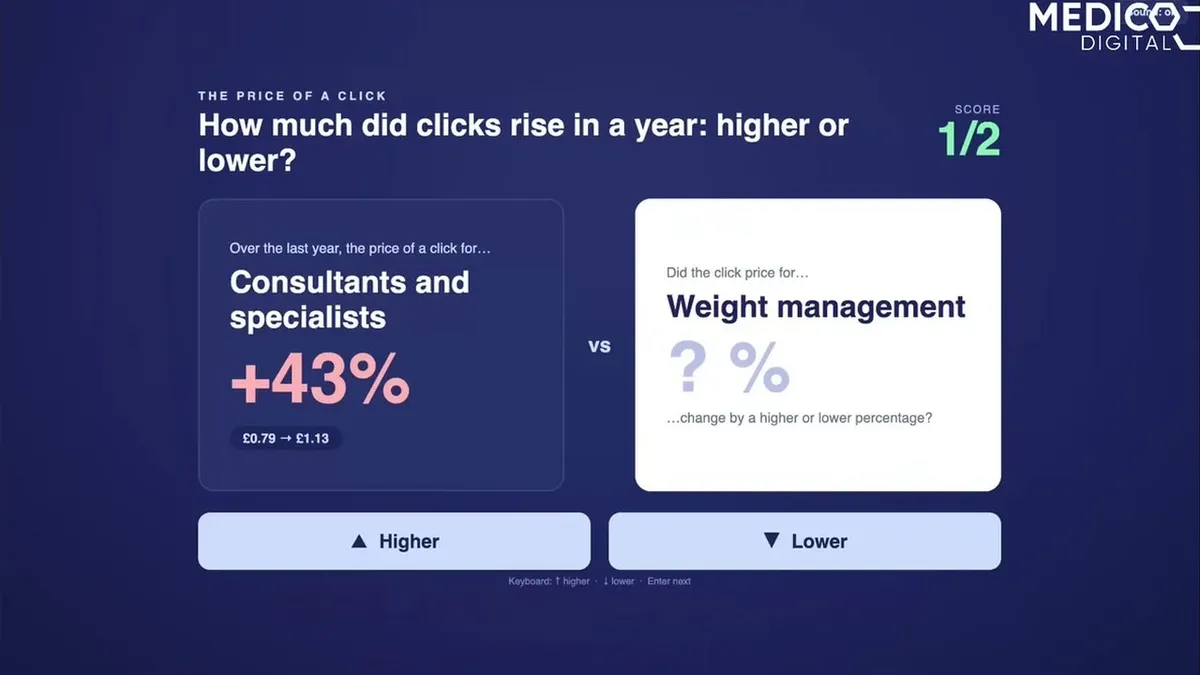
This is the game from the episode. Thirteen specialties, one at a time: higher or lower than the last. The table above has every answer in it, so feel free to skip.
A Medico Digital game show
The Price of a Click
One year of healthcare click price inflation, one specialty at a time. Guess whether each specialty’s price changed by a higher or lower percentage than the last.
13 specialties · about two minutes · the table above has the answers if you’d rather not play
The price of a click
How much did clicks rise in a year: higher or lower?
Over the last year, the price of a click for…
Did the click price for…
? %
…change by a higher or lower percentage?
Keyboard: ↑ higher · ↓ lower · Enter next
Final score
0/0
The house always wins: across identical campaigns, the average UK healthcare click rose 22% in one year. Weight management clicks rose 144%.
Weight management is the GLP-1 market being priced in real time. Private hospital intent, searches along the lines of private hospital near me, more than doubled off a 40p base as every smart bidding system in the market found the same undervalued auction at roughly the same moment.
Demand is growing, and it is pulling in new bidders. NHS waiting lists keep pushing first time self pay patients into search, and that has attracted competitors into auctions incumbents used to own: insurers, private equity backed clinic groups, and single specialty challengers going after one profitable slice of a hospital’s business.
There are fewer clicks to go round. AI Overviews and AI assistants are answering the research questions that used to produce a visit. Less volume, more advertisers, same auction. The price only moves one way.
Everyone is bidding the same way. Almost nobody runs manual bidding any more. Value based smart bidding means every competitor’s system is hunting the same subset of people, the ones most likely to book and pay, and those systems get sharper every quarter. Undervalued pockets get arbitraged away inside a couple of quarters.
Not everything went up. Gynaecology and urology clicks got cheaper over the same period, while their auction pools held or contracted. If you operate in one of those, this is the cheapest share you will buy for a while, and the window will not stay open indefinitely.
This is also a warning about how you read data like this. You will see plenty of aggregated cost per click reporting this year: healthcare up x%, retail up y%, financial services up z%. Inside this one sector the spread runs from falling prices to +144%. A sector average would have told you nothing useful about either end of it.
Track direction at specialty level. Account averages hide both the problem and the bargain, and industry averages hide even more.
Joe’s read across the accounts he manages is that conversion rates have mostly not moved. What has moved is the price of filling the top of the funnel. Standing still now costs more, which means the recovery has to come from conversion.
The arithmetic depends on where your conversion rate starts. Take a 5% conversion rate to 6% and you have absorbed a 20% rise in cost per click at a flat cost per acquisition. That is roughly this year’s inflation, recovered without touching a bid.
Where that percentage point usually comes from: pointing each keyword at the page that actually answers it, cutting form length, putting self pay pricing and finance options in front of the patient at the moment they are deciding, and being far more aggressive about which intents you are willing to pay for in the first place.
For hospital groups and multi service providers, the annual habit of dividing budget across services and letting it run is no longer defensible. Overweight the specialties where cost per click is falling and the auction pool is holding. Demand efficiency where inflation is outrunning demand growth. Treat the allocation as a live position and review it every quarter.
There is a concentration risk to deal with too. The accounts feeling this hardest are the ones most heavily invested in high intent, lower funnel search, because that is the most contested part of the auction. If every pound sits there, you have no shock absorber when prices move. Channel diversity is what buys you one.
This is the same argument we made across our e-commerceification series, arriving from the other direction. Once you know what a patient is worth across five years of treatment, you can afford to pay more than a competitor who only prices the first consultation. Lifetime value is what lets you win an inflationary auction on purpose, or sit it out on purpose.
Why this matters
Rising cost per click is market weather. You cannot negotiate with it and you cannot bid your way out of it.
The providers who lose the next two years will be the ones who respond by cutting budgets and capping bids, which reduces volume without improving economics.
The ones who win will treat it as a repricing: work out what a patient is actually worth, improve the conversion rate on the traffic they are already paying for, and move budget towards the specialties where the auction is still soft.
Who should watch this
- Healthcare marketers being asked by a board why cost per click has risen with no change in strategy
- Hospital and clinic marketing teams dividing a fixed budget across a portfolio of specialties
- Private practice owners in a single specialty who want to know whether their auction is one of the hot ones
- Anyone who has been handed a sector average benchmark and asked to plan against it
We are a specialist healthcare digital agency with over a decade of experience working with the UK’s leading private healthcare providers. Our access to anonymised, aggregated data across national hospital groups and independent practices gives us a unique lens on how patient behaviour is changing, and what to do about it.
Want to know where your specialties sit against these numbers?
We will benchmark your cost per click and cost per acquisition trends by specialty against what we are seeing across UK private healthcare, and show you which of your auctions is getting cheaper.
Get a complimentary paid media benchmark →← Stop renting your patients from Google. Start owning them.← 4 things your website should steal from Amazon← Proof your website doesn’t need to be a healthcare encyclopaedia