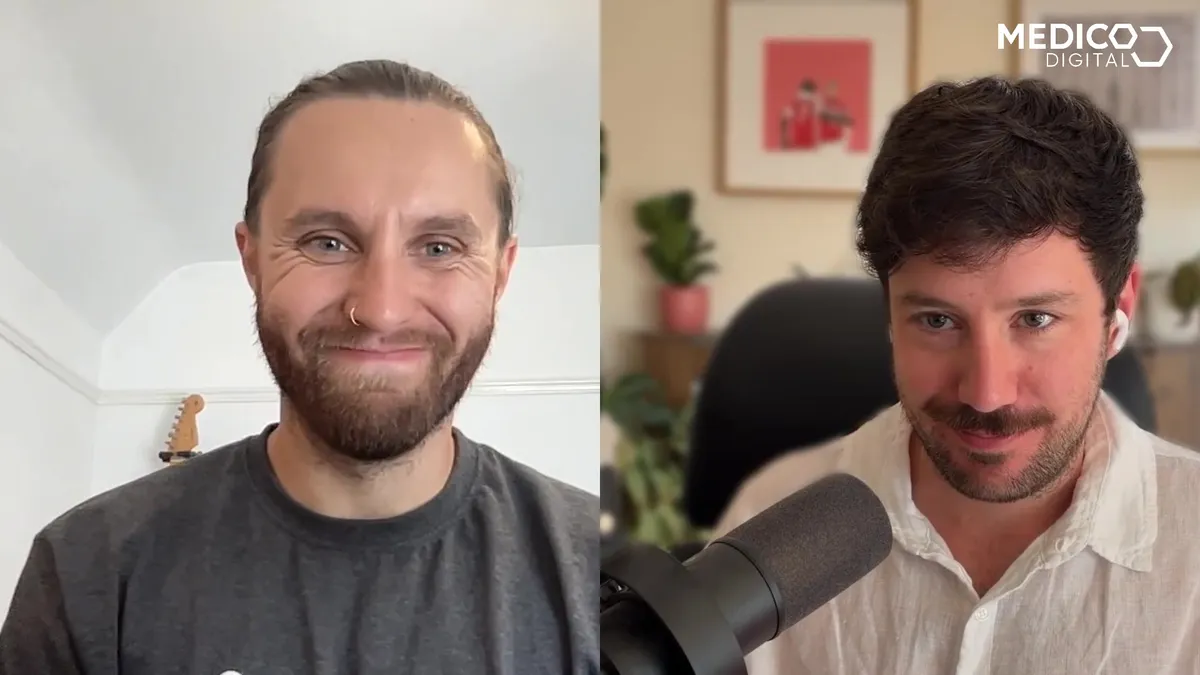
This is the second piece in our data series: aggregated, anonymised numbers from the paid media accounts we run across private healthcare - this time looking at when patients actually book, not just how much it costs to reach them.
Louis is joined by Medico’s commercial director Andy Kitchen to pull apart what the day of the week, time of day, and device someone is using tell us about how close they are to booking. The short version: weekends and nights are expensive for a reason, mornings are gold, and most provider websites are still sending very different types of searcher to the exact same page.
What we cover
Across the accounts we analysed, Monday to Friday cost per acquisition averages £13–£14. Saturday rises to £17, a 32% increase. Sunday rises to £22, a 71% increase.
Cost per click moves the opposite way: it gets cheaper over the weekend. Most platforms now run value based bidding, and they have learned weekend traffic is less likely to convert, so the auction prices it accordingly. Providers scaling down their own weekend operations, particularly phone response, reinforces the same pattern from the other side.
The same shape appears by time of day. Cost per click sits around £12 between 8am and midday, and rises to roughly £21 overnight. Impression volume and demand overnight stay high: people are still searching and landing on provider websites, they are just not booking there and then.
The likely read: overnight searchers are often worried about a symptom and researching, but are not ready or able to complete a booking in that moment. That research resurfaces the next morning, reflected in a sharp conversion spike between 9 and 10am, at 8.1%, the highest window of the day.
Cost per acquisition by day
Aggregated and anonymised across UK private healthcare paid search accounts.
| Period | CPA | vs weekday |
|---|---|---|
| Monday–Friday (baseline) | £13–£14 | — |
| Saturday | £17 | +32% |
| Sunday | £22 | +71% |
Cost per click by time of day
| Time of day | CPC |
|---|---|
| 8am–midday | £12 |
| Overnight | £21 |
Conversion rate peaks between 9 and 10am at 8.1%, the highest window of the day.
Conversion rate on mobile sits at 5.5%, against 8.6% on desktop. Some of that is friction: longer or more complex booking forms are harder to complete on a phone, and people may consciously wait until they’re at a desktop. Some may also reflect a demographic skew, with desktop users trending older and potentially more likely to convert for certain conditions.
Where budget is limited, saturating desktop impression share before pushing into mobile is worth serious consideration, even though “mobile first” has been the industry default for a decade.
The most striking finding: search intent around locality massively outperforms intent around procedure and price. Someone searching “hip replacement near me” or “knee replacement East London” converts at 3-4x the rate of someone searching “how much does a hip replacement cost.”
Despite a decade of SEO getting more sophisticated - semantic search, conversational queries, voice search, and now AI search - the simplest, most local intent signal still converts exceptionally well.
Most provider websites don’t treat these differently. A “near me” search, a locality search, and a price led search often all land on the same generic procedure page, even though these are different people at different points in the journey. Price led searchers are earlier in the funnel, not less valuable - they need cost transparency and a clear next step, not the same page as someone ready to book today.
Why this matters
Research doesn’t stop over the weekend. People just aren’t ready, or able, to book right then.
The providers getting this right aren’t cutting weekend and overnight spend to protect cost per acquisition. They’re treating that traffic as a different job: staying visible while research happens, then removing friction for the booking that follows a few hours or days later.
Who should watch this
- Healthcare marketers deciding how to split budget across the week and across devices
- Hospital and clinic marketing teams running a single generic landing page for every search intent
- Private practice owners who assume weekend and overnight spend is wasted
- Anyone thinking about how AI search changes what “conversion” even means
We are a specialist healthcare digital agency with over a decade of experience working with the UK’s leading private healthcare providers. Our access to anonymised, aggregated data across national hospital groups and independent practices gives us a unique lens on how patient behaviour is changing, and what to do about it.
Want to know how your account’s timing patterns compare?
We’ll benchmark your conversion rate by day, time, and device against what we’re seeing across UK private healthcare, and show you where the biggest gaps are.
Get a complimentary paid media benchmark →← Your cost per click went up 22% (don’t blame your agency!)← Stop renting your patients from Google. Start owning them.